Teaching with AI: A Practical Guide to a New Era of Human Learning, Second Edition
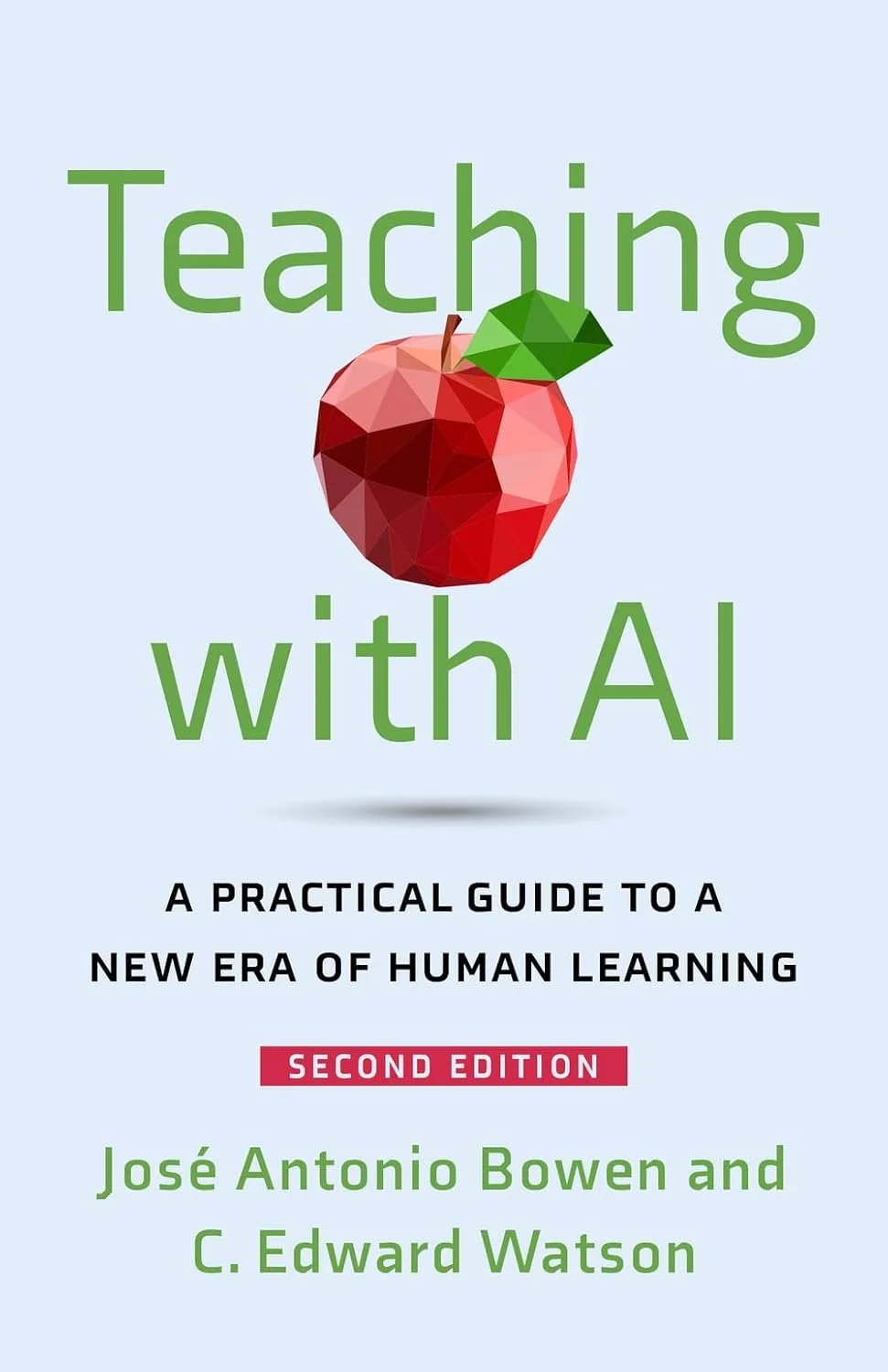
Teaching with AI: A Practical Guide to a New Era of Human Learning. Second Edition. By José Antonio Bowen and C. Edward Watson. Baltimore: Johns Hopkins University Press, 2026, 376 pp., $25.95.
Allow me to state plainly: in my opinion, this is the best and most accessible resource on AI for a faculty member that I have found. This statement is all the more defensible for a faculty member in the humanities, where prose writing, critical thinking, argument formation, and engagement with literature are often perceived as especially incompatible with AI. However, this is not to say that those operating in STEM fields cannot benefit from the read—quite the contrary. As this review is for Integration and a faith-based context, perhaps it is worth noting explicitly that the non-confessional nature of this resource should not be viewed as an obstacle for application in a confessional context. Faculty of Christian colleges, universities, and seminaries will benefit from the ideas in this volume with minimal or no contextual filtering. With this recommendation out of the way and since this is not an endorsement but a review, I will now turn to the substance of the volume.
The book is structured in three sections: Thinking with AI, Teaching with AI, and Learning with AI. As one might deduce, the book moves from the generally disruptive power of AI for society to how faculty may leverage AI in their craft and lastly to how faculty might facilitate learning for their students with AI. The movement from the first part to the last is logical and constructive.
The book has a decidedly practical focus (2). The aim is not to explore ethical or technical issues in detail. Nor is it a history of artificial intelligence, although the authors have chosen to begin with a brief history and description of AI. This flows quite naturally from their assumed audience of AI non-specialists. Thus, the AI Basics chapter establishes the basic lexicon and fundamental framework that the reader may need to engage with the remainder of the book. The chapter is void of technical jargon and convoluted explanations. Where technical language or concepts were unavoidable, the authors have provided periodic glossaries. The second edition has received important updates as the state of AI has changed from 2024 to 2026 (23–29).
The authors’ position is that AI will become an essential skill, and thus AI literacy will become important for faculty to integrate into their classrooms. Chapter 2 (A New Era of Work) defends this posture by surveying how AI is already changing the future work and careers of our students. The disruption for knowledge workers (in contrast to skilled tradespeople for previous technical revolutions) is a special focus of this chapter. If the chapter could be summarized by one of its sentences, it would be, “AI will eliminate some jobs, but it is going to change every job: those who can work with AI will replace those who can’t.” (33) Although the churn is still in flux, the authors’ claim should command the attention of every faculty member. The primary difference from the first edition is that this claim is less predictive and more of a report on the initial changes that are underway.
If AI Prompting will become an essential skill for graduates to demonstrate and for higher education institutions to cultivate, it follows that this is the focus of the third chapter, which was properly renamed AI Prompting in the second edition (cf. the title AI Literacy in the first edition). Identifying the problem, asking the right questions, utilizing the best-fit tool, engaging with better prompts, and progress through iteration all receive attention. It is significant to the authors’ argument that each of these skills is integral to critical thinking, which is already highly valued in liberal arts programs. This chapter is filled with concrete examples, sample prompts, and real responses from AI bots, which is its strength. The content of the chapter has been significantly reorganized in the second edition, an improvement over the first edition.
The book shifts in chapter 4 (Reimagining Creativity) from the immensely practical to a chapter on the creative prospects of AI. The authors aptly point out that the primary critique of AI (i.e. hallucinations) is a symptom of its uninhibited quality, which makes it an especially powerful partner for creative endeavors. Creativity and innovation spring from a critical mass of ideas (mostly bad ideas). AI can generate a dozen or a thousand ideas in seconds and does so without the social constraints that repress human creativity.
The first section of the book (Thinking with AI) concludes with a new chapter entitled AI Literacy. The focus of this chapter is on the curricular value of providing a working and mature knowledge of AI to our students but less as a professional skill and more as a life skill. This includes an ethical framework, an understanding of working with AI instead of outsourcing work to AI, which tools are best fit for certain work, how expertise supports AI usage, basic navigational skills, and so on. This more skeptical chapter is a welcome addition to the second edition and provides a healthier balance to the book.
Part II of the book, entitled Teaching with AI, has chapters dedicated to faculty work (6 and 7), cheating and detection (8), classroom policies for AI (9), and grading (10). The first two chapters are brainstorming exercises on various ways that a faculty member might utilize AI and are worth the price of the book. Chapter 6 (AI-Assisted Work and Research) is focused on research and writing. Chapter 7 (AI-Assisted Course Preparation and Beyond) deals with teaching and administrative work. Both chapters include less controversial uses of AI, but neither shies away from uses that may raise skeptics’ eyebrows. Together, these chapters provide a substantial challenge to any professor who believes that AI cannot aid their faculty work.
Chapter 8 (Cheating and Detection), as one would expect, is dedicated to the question of cheating and AI detection. An emphasis of this chapter is the unfortunate prevalence of false positives among AI detectors and the impact that false accusations might have on student well-being. This reality raises questions about the appropriate use of these tools by faculty and the importance of the human processes that are initiated by suspected misuse of AI. The chapter also provides some alarming statistics on the methods of and commitment to cheating, with and without AI. The chapter concludes with a helpful discussion on strategies to mitigate cheating, including the impact of good pedagogy.
The ninth chapter (Policies) connects logically with the question of cheating. As the authors state, “reducing cheating is good, but we also need to rethink our standards….” (132). This is the role of policy. The chapter is a helpful primer on connecting course policy on AI with the desired outcomes of the course, the values of the course, and any higher level departmental or institutional policies. The chapter concludes with a provocative but essential discussion on the redefinition of plagiarism.
The tenth chapter and the last in this section of the book (Grading and [Re-]Defining Quality) is dedicated to two related but distinct topics: elevating the quality of writing expected from our students and grading their writing with AI. Regarding the first, the chapter argues that if AI can earn a passing grade on our writing assignments, then we aren’t assessing quality at a high enough level. This is an important concept for those who believe that AI will only reduce the quality of our writing on a social level and impede real skill development in this area for our students. It is also a powerful argument for those of us who would like to see a corrective for the long-term patterns of grade inflation. The authors encourage us to leverage AI tools and rubrics to automate grading and even improve its fairness.
Chapter 11 (Feedback, Role-Playing, and Tutors) begins the third section of the book (Learning with AI) and outlines creative ways to utilize AI for student learning, first as feedback coach, then as a tutor, and finally as a conversation partner (i.e. for role play). Other minor uses are also considered. The chapter is full of helpful prompts and possible uses. They should help any professor offer custom and immediate feedback, provide a learning coach to their students 24-7, and manufacture practice scenarios that otherwise would be inaccessible to their students.
Chapter 12 (Designing Assignments and Assessment for Human Effort) addresses the psychology of assignment and assessment design, in an age of AI disruption. If professors expect students to engage their learning activities with motivation and integrity (i.e. not use AI to cheat), the assignment or assessment must give the student a compelling reason why it matters, offer clear instructions and resources, and uphold reasonable expectations for success. These aspects will help students value the process, and as a result allow AI to be leveraged for learning and not merely the outcome.
Chapter 13 (Writing and AI) challenges the professor to reconnect the purposes of writing for their students. Writing is often a means of thinking and learning, and writing assignments are far more valuable than the artifacts they produce. Therefore, in the age of AI, when we have means of writing without thinking, our writing assignments and processes must serve to reconnect “the why” of writing for the student, and our designs must create ways for the student to use AI without damaging the result of the process. The chapter offers many creative writing assignments and strategies for one to consider.
Chapter 14 (AI Assignments and Assessments) is built on the previous two chapters. The intent is to provoke and promote the design of assignments and assessments that exceed both what a student can do without AI and what AI can do on its own. It proceeds from the conviction that, in addition to the standard learning outcomes, all courses must build AI skills specific to the subject matter of the course. The belief of the authors is that this model both raises standards and prepares students for the new epoch of their profession. The diverse suggestions of this chapter are consistently provocative, even suggesting the professor invite AI to be a participant in his or her class, which creates opportunities to both critique and showcase AI all while building skill and literacy with AI in the students.
The final chapter (15) of this section and the book (Custom Bots and Beyond) is unique to the second edition. This chapter presents one of the primary advancements of the updated edition. Instructions and guidance are given for platforms which might be most useful for creating a custom bot, what the advantages of a custom bot might be to the professor and students, and what dedicated functions a custom bot may serve (a TA, a tutor, a feedback coach for papers, role-playing, simulations and gamification, etc.).
The book concludes with a brief epilogue that reflects on the challenges, choices, and changes that await education in the future and beyond the scope of the book. A final exhortation is given to the faculty reader to engage in this new era.
The three concrete strengths of this book all stem from its unapologetically practical focus. This book is not meant to be read; it is meant to be used. First, the primary strength of the book is the volume of sample prompts and ideas within the book. Whether a detailed prompt or a simple description of what one might be able to do with AI, the reader cannot help but brainstorm about how AI might be leveraged in their specific context. On more than one occasion (and at least once at the authors’ urging, on page 54), this reviewer put the book down to experiment. The authors have deliberately designed the book to engage the creative parts of their readers’ brains.
The second strength of the book is its distinctive focus on higher education. The authors have not addressed AI in a vacuum. They are approaching this subject from the context of use in higher education, and everything returns to this. Whether the specific work of the faculty member, pedagogical tips to enhance student motivation and disincentive cheating, the use of custom bots, or writing accreditation reports—everything has an anchor in the higher ed system. Even the impact of AI on jobs is repeatedly tied to the chief reason we do what we do—our students who will be competing for these jobs. If you are a faculty member or administrator in a college, university, or seminary setting, this is the AI book for you.
The third strength of the book that deserves to be highlighted is the holistic and integrated presentation of the authors. When addressing writing, they understand that it is not a black and white issue, and they remind us of previous disruptive innovations (today’s issues are not completely novel). When addressing assessment, they point to the long history of student cheating strategies. When addressing pedagogy in the AI age, they understand that the nontechnical and psychological aspects of design are as important as the methods employed—the why precedes the how. The amount of material controlled by Bowen and Watson in order to present the aspects of AI within such a long arc of history is truly remarkable.
The one weakness of the book is a matter of exclusion. There seem to be two separate conversations about AI in society right now. On the one hand there are those like Bowen and Watson who are more optimistic about AI and seem to want to help people maximally leverage this new technology. This group is not uncritical or naïve about the subject, but their intent and posture are more positive. On the other hand, another group, often approaching the topic from a more philosophical perspective, spends more of its time and breath cautioning against the threats and risks of AI. They are not averse to technology or AI, but they seem to approach this topic with a level of seriousness absent in the other camp. I understand that the issue is not this simple, but I have adopted this binary framework for heuristic purposes.
The balance and objectivity of this book would have been enhanced, in my opinion, by including some of the more philosophical concerns of the latter group. A fair treatment of these concerns, which I am certain the authors can deliver, would have given even more credibility to their work and a broader readership to this volume. Admittedly the second edition did include more of this than the first (e.g. 48–51, 93–101, 279, 317–26). However, a chapter dedicated to actual engagement with the other perspective would have been a further strength of the book.
On this note, the second edition is an improved version of the first, and this is to take nothing away from the excellent quality of the first edition. It was already an excellent, if not the best, resource on AI in higher education. A few aspects of the second edition are worth noting and have contributed greatly to the enhanced value of the new edition. The chapter on custom bots must be mentioned first. This is an aspect that has developed somewhat recently and possesses special potential for the audience and context of this book.
Second, the general updates to the technology and state of the field that have occurred since the publication of the first edition were well received and quite appropriate. These updates were not overwhelming, and the editions maintain their continuity, but they were noticed and appreciated when encountered. They were especially relevant in chapters 1, 2, 6, and 10.
Lastly, some organizational changes really aided the reader’s experience. In particular, the renaming of chapter 3 from AI Literacy to AI Prompting; the splitting of chapter 5 (AI-Assisted Faculty) into two chapters (AI-Assisted Work and Research and AI-Assisted Course Preparation and Beyond); and the reorganization of the material in chapter 3 all were noticed and all yielded a superior reading experience.
In conclusion, this volume remains a staple for thinking about AI in the context of education generally, and higher education particularly. It should find a place on the shelf (or desk!) of every professor, regardless of their posture on the subject or field of expertise. I welcome the revised edition and look forward to a steady schedule of updated versions in the future as we make our way through this technological and educational “revolution.”
R. Adam Dodd
Assistant Professor of Old Testament and Biblical Backgrounds, Vice President for Campus Technology, and Director of Tandy Institute of Archaeology | Southwestern Baptist Theological Seminary