Libraries of the Mind
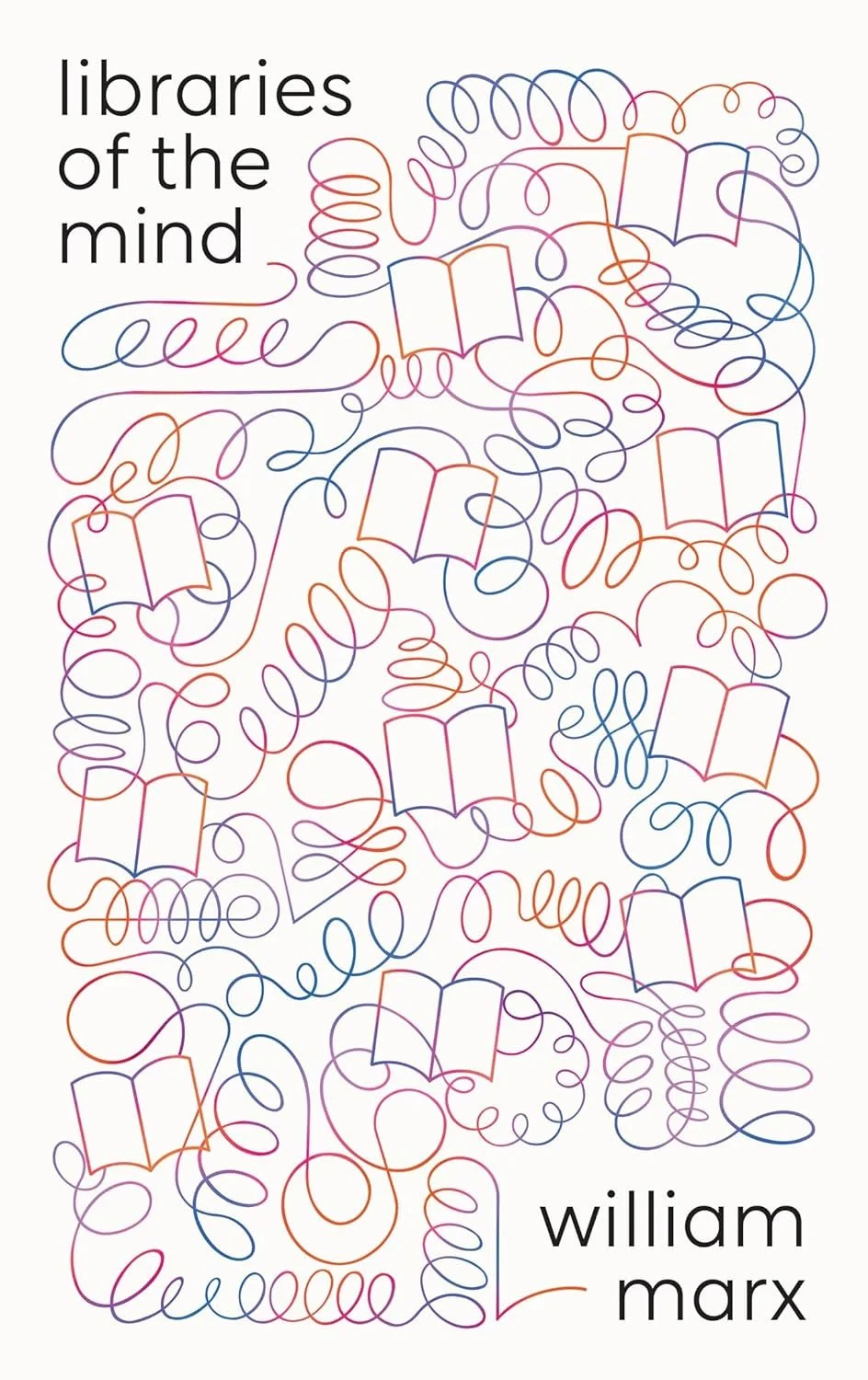
Marx, William. Libraries of the Mind. Princeton: Princeton University Press, 2025. Pp. 200. $24.95.
These three short essays began life as the 2022 Princeton University Press Lectures in European Culture delivered by the author at the Oxford Research Centre in the Humanities. Marx, professor of comparative literatures at the Collège de France, has traveled the world in his academic life, serving as a visiting lecturer throughout Europe, and Japan. These experiences have opened him to the world’s literature. Moreover, his reading of one culture’s literature in another culture and vice versa has prompted him to “compare” not only mainstream contemporary literatures but also disparate forms and divergent eras. These juxtapositions have generated the philosophical fodder for the three essays.
The first essay, carrying the book’s title, begins with the story of Erich Auerbach’s Mimesis and its genesis in an Istanbul bereft of European academic libraries. Auerbach sets aside the physical library with recourse only to his mental library. He relies upon his memory of great works of European literature to write what Marx calls “an unparalleled compendium of literary knowledge.” (1) Mimesis reveals a textual or visible form of the library resident within Auerbach’s mind. Marx proceeds to compare visible (concrete) libraries with libraries of the mind (invisible) and shows the tremendous importance and impact of invisible libraries, libraries that exist because of one’s deep reading.
Marx unfolds the concept of infinite libraries of the mind with recourse to the history of oral and written literature, the design of concrete libraries’ catalog systems of classification, and a deep philosophical discussion of the relationship between works and texts. He provocatively reminds us that all texts begin as the mental constructions of authors. The text or the printed material that we call a book is digested at the other end by the reader and then becomes part of the substance of that reader’s library of the mind. And so, the infinite cycles and iterations commence.
The second essay explores an area that is usually untouched in literary studies: the dark matter of literature. “Dark matter" is akin to that investigated at the cosmic level by astronomers, but Marx’s topic is more clearly defined: “the body of works that are known to have existed at some point or can be inferred to have existed on the basis of literary gaps and influences but are no longer accessible or were never recorded.” (75)
Marx develops a taxonomy for these works, beginning with those that are forever lost to us; those which we have in fragmentary form; those works that have been transformed through subsequent drafts or additions, utilizing genetic criticism and philology; those works that were never realized by the author (definitely dark, but I’m not sure this category could actually be “matter;” indeed, Marx admits that this category is “a very tiny bit more than mere nothingness” (98)); and finally, a type that Marx obviously champions: the neglected works. These are works that “have been preserved and transmitted, yet they languish in obscurity, overlooked for various reasons.” (99) Marx says that “it is imperative that we turn our attention to these overlooked treasures.” (101)
I think that Marx is unduly optimistic about the cultural attention span. It seems to be shrinking if anything. It would appear to be a fool’s errand to attempt to expand and broaden the canon (he doesn’t advocate replacement of the existing canon), while the current canon is increasing lying fallow. In terms of reading and the general populace, at least in the U.S., it seems that a campaign to return to the canon would be more invigorating, and possibly successful, than adding to the canon. But Marx may have a marketing edge; with the death of the monoculture in Western Europe and the U.S., it may be time to dredge up past works and give them a fresh reading to see if they are worthy of canon entry (something like a Veterans Committee ballot for the National Baseball Hall of Fame).
Marx ends this essay by returning to his first type of literary dark matter: works that are forever lost to us. We are aware of their temporary existence because their titles or authors’ names appear in lists or mere wisps of their content surfaces in other works. Sometimes all that is left is the shape of their contours in reflective and responsive works. Marx lays out two methodologies for recovering lost works: the direct, or genealogical, method and the indirect method. For the first method, Marx points to the JDEP theory (or Documentary Hypothesis) of the Pentateuch’s composition as an example. Identifying various strains of text allows the examiner to reconstruct original source works that were later compiled and edited to create the final document. These sources would be “lost works.”
Marx does acknowledge the “challenges” or problems with this methodology. This leads to the second method of lost work recovery. The indirect method, in Marx’s illustration, employs a multi-disciplinary approach: biological statisticians and medieval literature experts. They applied their tools to the extant corpus of Arthurian romances. Using species estimation technique, they were able to “determine” the loss rates of original works by language and region. He further demonstrates this method with appeal to his previously published work: a book, The Tomb of Oedipus: Why Greek Tragedies Were Not Tragic and an article, “How Canonization Formed Greek Tragedy.” His statistical work based upon historical investigation brought him to the conclusion that our contemporary understanding of Greek tragedy is deficient, but our knowledge could be improved by employing a lost works recovery project.
Marx’s final essay follows his “ethical and epistemological” call to “evolve our mental frameworks” in response to the invisible works of his second essay. This will require an expansion of our libraries of the mind, leading us to naturally look beyond territorial borders to discover the exotic other. Marx works through several layers of an appropriated anecdote, finally establishing its origin, in ancient China. He demonstrates that the later presentations of the story had progressively discarded alien features of the story until it was domestically subdued. According to Marx, world literatures are at risk of the same process in foreign cultures, so he warns us to be sure to read them and allow them to stand in their unfamiliar and uncomfortable (to us) garb.
Marx commences a history of world literature, a concept that he regards as “superficial.” He laments the decline of literature over the centuries as works evolved into texts, and texts became disconnected from their original contexts and were treated as economic commodities. The idea of “intentional fallacy” has brought into existence a world where every reader and their feelings are “right.”
In the face of this populist postmodernism, Marx reminds us of the “otherness” of world literature. Moreover, he recognizes that otherness is not distance-dependent, that otherness can originate next door in a multicultural environment. But he does not want us to be bound by the multiplicity of identities in our contemporary world. At one moment, he expresses dismay that texts are going hither and yon, while at the next he says, “there is no true crime of cultural appropriation.” (139) Texts should travel freely, since they are not like a singular cultural artifact, like the Parthenon friezes.
Marx asks if we should bow to presentism, refusing to read texts that do not match our contemporary sensibilities (i.e., should they be cancelled?) He argues for the value of the flawed writings of the past, so as to demonstrate progress. But they should operate as more than “relics of a repudiated past,” (141) otherwise they will not receive a full hearing. Marx sees the dominant ego of our age as the looming threat to properly reading literature. If the self is unassailably superior, no text can touch it, and “an inquisitorial approach to reading prevails.” (142) Marx also fears homogenization, that only the most benign works are translated, so we have an impoverished world literature. We may see the scarcity statistics of translations change rapidly in the next decade with the advent of AI-supported translation work. We may see less marketable and inconvenient texts pouring into the global marketplace.
Marx concludes his final essay with a call to the spirit of a world library not merely a curated list of world literature. He challenges us to read that which makes us uncomfortable. I think that he intends that to be our constant posture, of suffering at the hands of our texts. Rather than the ego ruling the text, he says “we should, at least temporarily, submit ourselves to the mystery inherent in each text we encounter.” (151) This sacralization of every text as a work of art that should not only be read but that reads us could stimulate a sleepy academia. Undergraduates who no longer read and professors with spent critical theories need the shock to the system that Marx predicts will come when the world library does its magic: “an encounter with otherness that is both transformative and profound.” (160)
Marx’s theory of the library of the mind and the world library sound much like the Christian doctrine of Holy Scripture. He desires us to see texts as more than words on a page. He wants us to read so deeply that the work of the author becomes internalized. And when we have imbibed and eaten the text, we will carry it with us (the Libraries of the Mind), and it will say to us, “you must change your life.” (161) This alien word that comes to us (the World Library) will challenge our prejudices and cause us to feel uncomfortable. In a world of trigger warnings, Marx calls us to “a true engagement with literature” that “demands humility, openness, and a readiness to be transformed by the unknown.” (161)
J. Michael Garrett
Librarian & Director, Ryan Center for Biblical Studies | Union University