
Jesus and Divine Christology
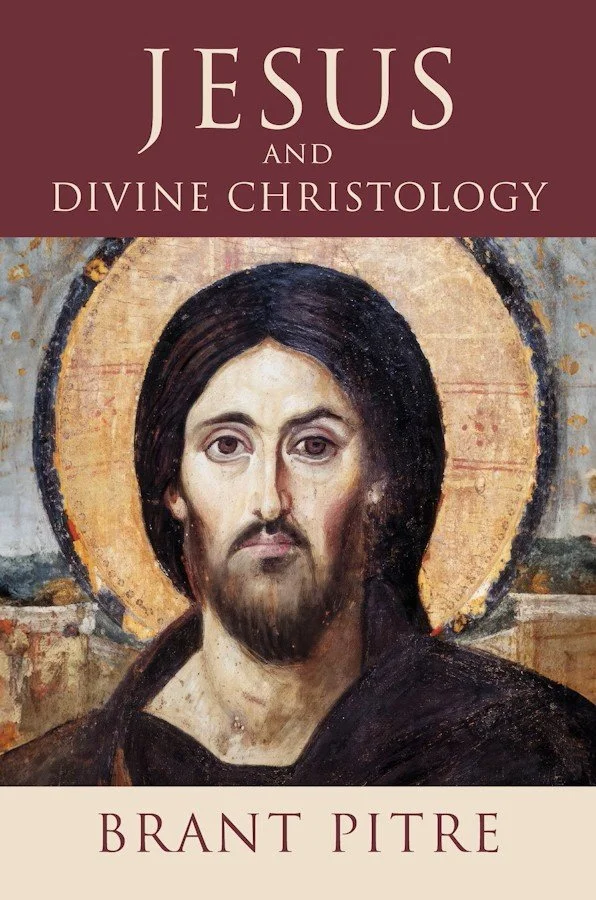
Pitre, Brant. Jesus and Divine Christology. Grand Rapids: Eerdmans, 2024, viii + 408 pp. Paper, $39.99.
Historical Jesus research is a field that prompts a great deal of overstatement, wild differences of opinions, and significant debate over methodology and conclusions. Given that, by most estimates, the quest for the historical Jesus began over 250 years ago when G. E. Lessing published Hermann Samuel Reimarus’s Wolfenbüttel Fragments, one would think that there would be nothing new left to say on the subject. Yet, surprisingly, there is, as this review will demonstrate.
One area of research that is at long last being seriously investigated is the question of whether Jesus claimed to be divine. Note well: the question is not whether Jesus was or is divine, or even whether the Gospel authors believed him to be divine, but rather, does a historian who does not appeal to the New Testament Gospels as authoritative sources have reason to believe that the historical person Jesus claimed to be divine? Brant Pitre’s Jesus and Divine Christology takes up this question.
Pitre organizes his book into six substantial chapters including his introductory chapter, “The Quest and Jesus’s Divinity,” and his concluding chapter, “Implications.” Pitre consistently summarizes what other scholars have thought but he also frequently demonstrates their conclusions with telling quotations, thus displaying the extent to which he has closely read the relevant material. I applaud this sort of “show and tell” writing. He also draws widely from non-religious and Jewish scholarship on Jesus as well as Christian.
In his introductory chapter, Pitre notes an apparent conflict between contemporary historical Jesus studies and contemporary New Testament Christology in that a growing number of historians of all stripes (Christian, Jewish, and non-religious) assert that belief in Jesus’s deity arose very early, but few think that Jesus understood himself to be divine.
To sum up what we’ve seen so far: although the vast majority of contributions to the modern quest agree that the historical Jesus never claimed to be divine, recent studies of the early church also agree that Jesus was regarded as divine in some sense from the very beginning. This somewhat paradoxical pair of hypotheses raises an important historical question: If Jesus himself never claimed to be divine in any sense, then how do we explain the origins of early high Christology? (10, italics in original)
Pitre’s explanation is clear and direct:
In this study, I will argue that the best explanation for why the earliest Jewish followers of Jesus believed he was divine shortly after his death is because Jesus himself spoke and acted as if he were divine during his lifetime. Indeed, when we interpret the words and deeds attributed to Jesus in a first-century Jewish context, a strong case can be made that the historical Jesus claimed to be divine, but he did so in a very Jewish way—using riddles, questions, and allusions to Jewish Scripture to both reveal and conceal the apocalyptic secret of his divinity (12, italics in original).
Pitre offers four historical warrants for “undertaking such an investigation” (12). They are: (1) early Jewish evidence for divine messiahs;[1] (2) a growing recognition that the historical Jesus saw himself as Israel’s messiah; (3) Jesus made divine self-claims in the Synoptic Gospels as well as the Gospel of John; and (4) other historical figures in the Second-Temple period claimed to be divine (12-24).
As to his method, Pitre adopts the triple-context approach of E. P. Sanders in Jesus and Judaism,[2] which highlights: (1) contextual plausibility within first-century Judaism; (2) coherence with other evidence about Jesus; and (3) consequences in the early church (24-39). I will have more to say about this later.
In chapters 2-5 Pitre organizes episodes from the New Testament Gospels into four overarching groups: The Epiphany Miracles (chapter 2); The Riddles of Jesus’s Divinity (chapter 3); The Apocalyptic Secret (chapter 4); and Crucified for Blasphemy (chapter 5).
Chapter 2 focuses upon three miracles that reveal Jesus, in a very Jewish way, as being in some sense equal to the one God of Israel:
1. Stilling of the Storm (Matt 8:23–27; Mark 4:35–41; Luke 8:22–25)
2. Walking on the Sea (Matt 14:22–27; Mark 6:45–52; John 6:16–21)
3. The Transfiguration (Matt 17:1–9; Mark 9:2–9; Luke 9:28–36)
Pitre goes against the grain by highlighting a select group of miracle narratives attributed to the historical Jesus in arguing that miracles can reveal the identity of a historical figure. One oddity of contemporary Jesus research is that, while one of the most widely agreed upon conclusions is that Jesus was understood to be a miracle worker, most scholars do not address what his reputed miracles tell us about who he was. No doubt some ignore his miracles because of philosophical commitments to metaphysical naturalism (miracles don’t happen), others because of a commitment to methodological naturalism (historians should bracket supernatural, i.e., miraculous, claims). Having stated his method, Pitre applies his method and considers evidence for and against its historical plausibility. In this way, he considers not only what Jesus is reported to have said but also what he is reported to have done.
I found the most interesting of Pitre’s three “epiphany” miracles to be his treatment of the transfiguration. Historical Jesus scholars have generally ignored this event, or perhaps more accurately, have isolated it due to its supernatural nature and considered it non-historical. Pitre argues persuasively not only that it is a Theophany but also explains why Moses and Elijah are the two characters from the Hebrew Bible (Christian Old Testament) that interact with Jesus on the mountain. Moses and Elijah came close but never saw the face of God in their ministries but now they do see God in the face of Jesus. Pitre consistently applies his method when considering each of his three selected miracles.
Chapter 3 focuses upon Jesus’s use of parables (Hebrew Mashal; Greek Parabolē) and emphasizes the wide range of meanings that parables could have in ancient Judaism beyond stories with a point. Pitre seizes upon three riddle-like sayings of Jesus that when understood from the perspective of Second Temple Judaism reveal but also conceal Jesus’s divine identity.
1. “Greater than Father or Mother” (Matt 10:37; Luke 14:25-27)
2. “No One is Good but God” (Matt 19:16-22; Mark 10:17-22; Luke 18:18-23)
3. The Riddle of “David’s Lord” (Matt 22:41-46; Mark 12:35-37; Luke 20:41-43)
Pitre’s focus upon the “greater than father or mother” passages was the first time that I’ve ever seen anyone argue that Jesus’s demand that his disciples must love him more than father or mother constituted a claim to divinity. Not only was Jesus’s demand shocking, but Pitre’s inclusion of it as evidence that Jesus acted in ways that showed he was equal with his heavenly Father was also persuasive, in my opinion. Pitre marshalled an impressive amount of evidence to support his claim that in the Hebrew Bible only God was greater than one’s parents, and that by demanding that his disciples love him more than their parents, Jesus was in effect claiming to be equal to the heavenly Father.
Chapter 4 focuses upon passages that are understood to be apocalyptic when interpreted through a Second-Temple Jewish lens.
1. The Heavenly “Son of Man” and the Healing of the Paralytic (Matt 9:2-8; Mark 2:1-12; Luke 5:17-26)
2. The Question of John the Baptist: “Are you the one who is to come, or are we to wait for another?” (Matt 11:2-6; Luke 7:18-23)
3. The Apocalyptic Thunderbolt (Matt 11:25-27; Luke 10:21-22)
The healing of the paralytic in response to the question, “who can forgive sins but God alone?” is in my (not particularly unique) view one of the most important and obvious examples of Jesus saying and showing that he has the authority in and of himself to forgive sins, not simply to communicate God’s forgiveness of sins. This passage could also have been included in the fifth chapter because it lends itself to the charge of blasphemy (and the blasphemy charge at Jesus’s trial from the fifth chapter could be included in this chapter because of Jesus’s claim to be the Son of Man), showing that some pericopae are richer than others and thus can fit into more than one category.
Chapter 5 focuses upon the charge of blasphemy and Jesus’s resultant death.
1. “They Picked up Stones” (John 8:48-59)
2. “You Make Yourself God” (John10:22-39)
3. The Charge of “Blasphemy” at Jesus’s Trial (Matt 26:57-66; Mark 14:53-64)
I found this chapter to be the most interesting in the book for two reasons. First, Pitre is not afraid to call upon John’s Gospel for historical evidence. Such a move is not common in historical Jesus scholarship, but it is long overdue. I am not alone in this opinion. See the recent publications from the John, Jesus, and History section of the Society of Biblical Literature for proof of this claim.[3] Second, Pitre wisely follows his Doktorvater, John Meier, in asserting that any theory as to who Jesus was, and understood himself to be, must be able to provide evidence that explains why he was crucified. This chapter shows that there is far more evidence for the charge of blasphemy than there is for any other alternative charge (messianic pretender, false prophet, spoke against the temple, spoke against the Torah, led the people astray). This chapter challenged establishment scholarship on multiple points.
In his final chapter, “Implications,” Pitre summarizes what he has done up to this point and draws some conclusions. He admits that he has barely scratched the surface of what could be said about Jesus; indeed, he has analyzed only 12 of Kurt Aland’s 365 identifiable pericopae from the four first-century Gospels (474).[4] He argues that he has demonstrated that the common trope of “Jesus never claimed to be divine” is not only simplistic but also erroneous. It is not even careful historiography because it must ignore a mountain of evidence to the contrary.
He then lists the major alternative explanations for the origin of early high Christology, such as (1) belief in Jesus’s deity evolved from the influx of Hellenistic believers due to Paul’s missionary endeavors; (2) the Gospel of John coupled with Jewish views of divine agents led to a gradually unfolding belief in Jesus’s deity; (3) Paul’s unique Christology—Jesus was preexistent—led to a view that was seriously at odds with Jesus’s own self-understanding [essentially Paul, not Jesus, was the founder of Christianity]; and (4) belief in Jesus’s deity grew out of Jesus’s first disciples having [usually visionary] experiences of the risen and exalted Jesus (453). Understandably, Pitre does not address any of these in detail, but he does state:
I simply want to point out that the one thing they all have in common is the assumption that Jesus himself did not claim to be a divine messiah during his public ministry; nor did his disciples believe he was divine during his lifetime. It is precisely the assumption that Jesus never claimed to be divine that this study has called into question. For if the historical Jesus did indeed speak and act as if he was a divine messiah during his public ministry, and if he was accused of blasphemy on more than one occasion as a result, and if he ultimately “died for his self-claim,” then every one of the early high Christology hypotheses listed above would be fundamentally flawed and in need of serious revision (453-54).
He singles out the common belief of Jesus’s disciples that the resurrected Jesus had appeared to them for special attention as an alternative explanation for an early high Christology because it is the most prevalent and serious of all the alternative explanations. After a brief examination of the issue, he determines that resurrection appearances were a necessary rather than a sufficient condition for any early high Christology. He concludes, “Instead, the most probable explanation for why Jesus’s earliest followers spoke and acted as if he was divine after his death is because Jesus himself spoke and acted as if he was divine while he was still alive” (457).
He then gives attention to the frequent charge that it was not until the Council of Nicaea (325 AD) that Christians determined once and for all that Jesus was indeed more than human. Pitre astutely notes that Nicaea was not about whether Jesus was a divine or human savior. Instead, Nicaea was about what kind of deity Jesus possessed; the council never considered whether Jesus was merely human because nobody at Nicaea considered that a serious option. This can easily be seen by noting that none of Nicaea’s anathemas states anything about Jesus being human as opposed to divine. He notes, “there is not a single anathema against ‘those who say that Jesus is not God’ or ‘those who say the Son is not divine’” (466). Second, he notes that the earliest Christology was not only a High Christology but also a Low Christology. In effect, he argues not only that Nicaea traced its way back to the life of Jesus but also that Chalcedon did as well.
Jesus and Divine Christology is a powerhouse book that can be read with remarkable ease; its content is matched by its clarity. Still, a few remarks are in order. The application of criteria of authenticity can be both a positive and a negative feature in historical Jesus research. Positively, the use of criteria shows that a historian is aware of the importance of a conscious and consistently applied historical method. Negatively, criteria may be abused to serve a historian’s agenda. There is, for instance, the danger of using criteria as requirements for authenticity rather than as indications of authenticity. In fact, my look-around-town epistemology tells me that the criteria are usually abused, i.e., they are generally used to rule out material deemed objectionable to scholars of various perspectives. Furthermore, there are numerous proposed criteria (I suspect only God knows how many have been proposed), and there is no consensus as to which criteria should be used. Predictably, this often results in scholars choosing from the multitude of potential criteria those criteria which most favor their predetermined conclusions. I am not alone in this opinion. Chris Keith, Anthony Le Donne,[5] Morna Hooker,[6] and Dale Allison[7] have all published vigorous critiques of the use of criteria. Should one conclude that I am opposed to the use of any criteria, that is most decidedly not the case. So long as criteria are used as indications of authenticity rather than requirements for authenticity, I am in favor of their application. Having said that, I do not think that thinking of criteria as necessary is helpful. Nor do I believe that simply meeting—or failing to meet—a subjectively chosen set of criteria guarantees that the historian has objectively determined the authenticity or inauthenticity of any report of what Jesus said or did. Instead, when a pericope meets some criterion, such as being multiply-attested or is dissimilar from what we commonly believe about the early church and second-temple Judaism, that should be noted and taken into consideration alongside other things that good historians will consider in reaching their conclusions.
We always need to bear in mind that history is an abductive endeavor, i.e., reasoning to the likeliest explanation of the available evidence. Historians always need to have an appropriate appreciation of the degree to which history can be conducted as a science yet never forget that history done well is not merely a science. In other words, history is also an art. We must particularly bear in mind that history is always an interpretive task: contemporary historians are reading and interpreting earlier authors who were also historians. Interpretation is not something that can be reduced to a method, and especially not a method solely patterned on the physical sciences. At the end of the day, the sensitivity and skill of the historian as an interpreter is still the most crucial component in searching for Jesus.[8]
Having said that, Pitre’s use of E. P. Sanders’s three criteria: (1) contextual plausibility within first-century Judaism; (2) coherence with other evidence about Jesus; and (3) consequences in the early church seems to me to avoid any blatant abuse. At no point does Pitre explicitly rule out any passage due to its failure to satisfy his threefold criteria. Indeed, Pitre consistently uses his chosen criteria as indications rather than as requirements for authenticity. Furthermore, in chapters 2-6 he considers alternative explanations and objections to his conclusions. Still, one wonders whether he would have chosen other pericopae to study had he not had these criteria. In other words, even when used appropriately, criteria cannot help but influence which pieces of evidence will be assessed.
Pitre is writing about the historical Jesus, but he is not giving us a full-blown picture of the historical Jesus along the lines of Strauss, Schweitzer, Wrede, Sanders, Crossan, Wright, Meier, or Dunn, to name just a few, who have given us fuller portraits of Jesus. Instead, his focus is upon the considerable evidence that indicates that Jesus said and did things prior to his crucifixion that, when viewed from a Second Temple Jewish perspective, make it clear that he considered himself in some sense equal with YHWH. He examines twelve pericopae which arguably present Jesus as doing that very thing. I, for one, am persuaded that Pitre has made his case.
Careful readers will no doubt notice that Pitre appears to have an unstated purpose, namely that of Christian apologetics. Perhaps this purpose is unstated because, among historical Jesus scholars, there is a bias against apologetics, which is a hangover from form criticism’s bias against history. I have not read any reviews of Jesus and Divine Christology (I did not want to be unduly influenced by doing so), but I expect that not every reviewer will welcome its thesis, and that some will conclude that it is nothing but an apologetic for high Christology. The word “apologetic” is found only once in the book and that in a quotation from Robert Funk and the Jesus Seminar intended to demonstrate that because Jesus’s response to John in Matt 11:2-6//Luke 7:18-23 appears to be apologetic in nature it could not possibly be historical (323).[9] Apologetics should not be a dirty word to historians—there is nothing necessarily in conflict between apologetics and history—especially since all historians have agendas, and thus the majority argue for their views and against the positions of others.
Pitre does not address in a sustained fashion the most obvious reason that critical scholars reject the historicity of the passages that Pitre considers, namely a commitment to the presuppositions of form criticism.[10] Despite the fact that form criticism is in decline, many critical scholars, perhaps even the majority of critical scholars, still affirm some of the chief tenets of form criticism, particularly those tenets concerning the formation of the New Testament Gospels. Alarmingly, many contemporary scholars fail to appreciate the degree to which they have subconsciously absorbed the presuppositions of form criticism, and their historical methods suffer as a result.[11] This is probably because many scholars have not discerned the difference between the two-source hypothesis itself (as well as the four-source hypothesis) and the form-critical shrink wrap in which it is often packaged.
My contention is that no solution to the synoptic problem is going to be able to determine which reports of Jesus are historically authentic versus those which are historically inauthentic (if any are). Pitre seems to agree with me, at least in part, when he notes that:
Albert Schweitzer pointed out over a century ago, in the final analysis, the Synoptic problem is “a literary question” that is methodologically incapable of answering “the historical problem” of whether Jesus did or said any of the things reported in the Gospels. Whatever solution one adopts to the question of the literary relationship between the Gospels, we are still left with the historical plausibility or implausibility of any given saying or action attributed to Jesus, which must be evaluated on other grounds (31-32).
Form criticism has done more damage than good, and in my view the time has come for it to be relegated to the dustbin of history when it comes to historical Jesus research.
Pitre’s target, however, is not form criticism itself but rather the assertion that the historical Jesus did not claim to be divine. He offers his readers a well-reasoned and systematically tested theory as to why there is evidence that the earliest followers of Jesus believed that he was divine very soon after his death. His conclusion is that “the ‘smoke’ of early divine Christology originated in the ‘fire’ of Jesus’s own divine messianism” (452, italics in original).
Conclusion
We owe Brant Pitre a debt. Jesus and Divine Christology is a groundbreaking book that, in Chris Tillings’s words, is a “‘scholarly majority’ buster” (rear book flap). My few concerns are merely quibbles. I have no doubt that many will not agree with Pitre but that is simply the nature of scholarship and human beings. After all, if Pitre is correct, our Creator came among us and revealed himself in multiple ways to witnesses who should have understood what he was saying and doing—and most of those witnesses rejected him. Furthermore, if Pitre is correct, historians should be able to see that Jesus himself taught in multiple ways that he was equal to the one God of Israel.
Notes:
[1] Interestingly, Pitre cites other contemporary, i.e., secondary, sources on historical Jesus rather than ancient sources. I found this an odd move, especially since some of his cited sources, when read in context, are actually denying the point that he is attempting to make in this section.
[2] E. P. Sanders, Jesus and Judaism (Philadelphia: Fortress, 1985).
[3] Paul Anderson, Felix Just, and Tom Thatcher have edited three impressive volumes from the Jesus, John, and History section. See Paul N. Anderson, Felix Just, and Tom Thatcher, John, Jesus, and History, Volume 1: Critical Appraisals of Critical Views (Atlanta: Society of Biblical Literature, 2007); idem, John, Jesus, and History, Volume 2: Aspects of Historicity in the Fourth Gospel (Atlanta: Society of Biblical Literature, 2009); and idem, John, Jesus, and History, Volume 3: Glimpses of Jesus through the Johannine Lens (Atlanta: Society of Biblical Literature, 2016). For more on the John, Jesus, and History group see https://johannine.org/JJH.html.
[4] Kurt Aland, ed., Synopsis Quattuor Evangeliorum, 15th rev. ed. (Stuttgart: Deutsche Bibelgesellschaft, 1996).
[5] Chris Keith and Anthony Le Donne, eds., Jesus, Criteria, and the Demise of Authenticity (New York: T&T Clark, 2012).
[6] Morna D. Hooker, “On Using the Wrong Tool,” Theology 75 (1972): 570–81; Hooker, “Christology and Methodology,” New Testament Studies 17 (1970–71): 480–87.
[7] Dale C. Allison Jr., “How to Marginalize the Criteria of Authenticity,” in The Handbook for the Study of the Historical Jesus, ed. Tom Holmén and Stanley E. Porter (Leiden: Brill, 2010), 1:3–30.
[8] For more on this, see Robert B. Stewart, The Quest of the Hermeneutical Jesus: The Impact of Hermeneutics on the Jesus Research of John Dominic Crossan and N. T. Wright. Lanham, MD: University Press of America, 2008.
[9] Robert Funk, W. Roy Hoover, and the Jesus Seminar, The Five Gospels: The Search for the Authentic Words of Jesus (New York: Macmillan, 1993), 178.
[10] Redaction criticism, which was a course correction from form criticism in that it correctly viewed the Gospels more as whole documents than fragments which were crafted in theological quilts and did not bracket theological conclusions but rather saw them as literary explanations, still assumed most of the faulty presuppositions of form criticism. Whereas form criticism appealed to an anonymous early Christian community rather than Jesus as a referent for various Gospel sayings, redaction criticism merely hypothesized an anonymous early Christian editor: both ultimately refused to see Jesus himself as a source for inconvenient beliefs.
[11] The application of criteria is not in and of itself a problem but form critics typically overreach and require criteria such as multiple attestation and dissimilarity to label an unreasonable amount of the New Testament Gospels as inauthentic. Historians should be cautious about being guided by a theory as to the formation of the New Testament Gospels that depends upon hypothetical sources, such as Q, M, and L, that nobody has ever seen apart from material contained within the New Testament Gospels to deem as nonhistorical pericopae for which we do have actual literary evidence. This is an entirely unique approach within ancient history; historians judge no other historical figure that I know of in this way.
Robert B. Stewart
Professor Emeritus of Philosophy and Theology I New Orleans Baptist Theological Seminary